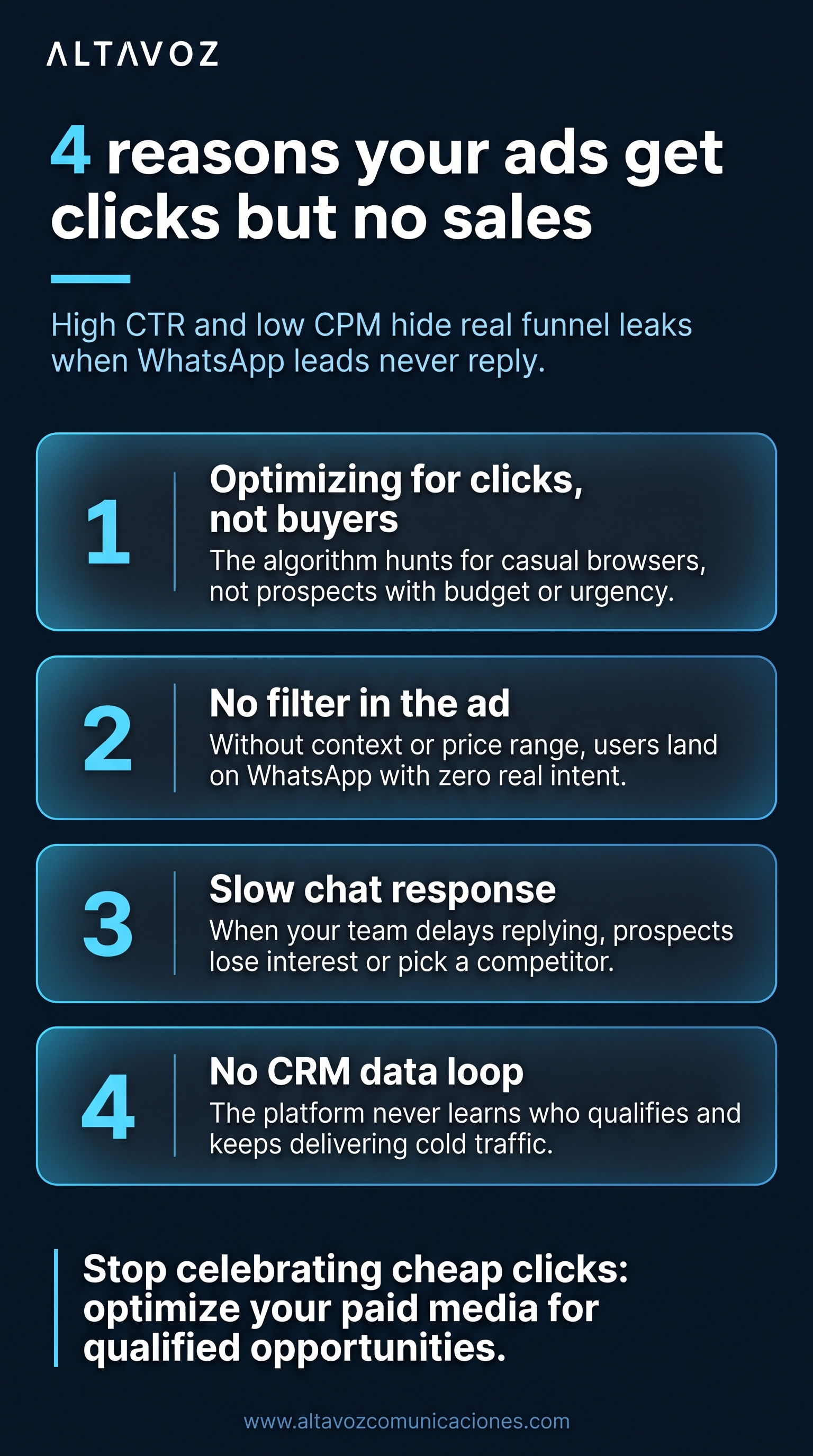
Your marketing team celebrates the weekly report: cost per click dropped, CTR outperforms the industry benchmark, and clicks to WhatsApp grow every month. Yet when you ask the sales team about closed deals, the answer is always the same: leads don’t reply, ask for the price and vanish, or don’t even remember clicking the ad.
This guide helps you diagnose why platform metrics hide serious leaks in your customer acquisition and outlines the operational adjustments needed to turn clicks into real conversations. It is built for startup founders, Growth leaders, and commercial directors investing in paid media who need profitability, not empty volume.
The CTR and CPM mirage: optimizing for the platform, not the business
Ad platforms like Meta Ads and TikTok Ads are extraordinarily efficient at following the exact instruction you give them. If you configure a campaign to optimize for link clicks or started conversations, the algorithm will hunt for users most likely to tap buttons—not those with budget, urgency, or buying intent.
A low CPM usually signals that you are reaching broad, uncompetitive audiences, often well outside your ideal customer profile (ICP). Similarly, a high CTR can simply be the result of a creative built for curiosity or entertainment, disconnected from the actual value proposition of your product or service.
When marketing is evaluated solely on cost per lead (CPL) or incoming message volume, the operational incentive is clear: drive down the cost per click at all costs. The result is a steady stream of low-intent traffic that clogs your sales operation and inflates your real customer acquisition cost (CAC).
What to verify: Cross-reference your highest-CTR ads against actual response rates in your CRM or WhatsApp inbox. Identify which creatives generate cheap clicks but zero qualified opportunities.
Red flag: Your agency or internal team delivers monthly reports highlighting only impressions, reach, CTR, and CPL, with no visibility into how many leads progressed to a meeting or proposal.

Intent friction: the gap between the ad and the chat
Users scrolling through social feeds are in passive discovery mode, not active buying mode. When an ad promises a generic outcome or uses an overly aggressive hook ("discover how to double your revenue"), the click happens on impulse, not evaluated need.
By jumping straight from the feed into a WhatsApp chat without an intermediate page or pre-qualification filter, the user has not processed what you sell, how it works, or what the investment range looks like. When they open the chat and hit an automated message asking for company details, friction outweighs interest and they drop off.
In B2B models or mid-to-high-ticket services, removing all friction is counterproductive. Eliminating every barrier in the ad increases top-of-funnel volume, but dumps all the filtering and education work onto the sales team, who end up spending hours chasing cold contacts.
- How to apply it: Introduce useful friction in the ad and the first touchpoint. Explicitly state who your solution is for, include a starting price range or minimum requirement in the copy, or route traffic to a concise landing page before enabling the WhatsApp button.
- Mistake to avoid: Using pre-filled WhatsApp messages that only say "Hi, I want more information." That prompt neither forces the user to confirm intent nor gives your sales rep context to reply with precision.
The operational bottleneck in WhatsApp response
Even when an ad attracts a prospect with a genuine need, the deal is often lost in the first few minutes after the click. On conversational channels like WhatsApp, the expectation for a reply is immediate; if your team takes hours to respond, the user has already returned to their routine, forgotten your brand, or solved their question with a competitor.
The second operational failure happens in the response script. Many sales teams reply with massive blocks of corporate text, drop a heavy PDF without context, or put the prospect through a rigid six-question interrogation before offering value. The buyer perceives bureaucracy and leaves the chat on read.
Furthermore, without structured CRM tracking that links the ad source to the conversation status, it is impossible to know whether leads "aren’t replying" because of poor targeting or because commercial follow-up stopped after a single uninspired message.
- What to ask for: Require a defined maximum first-response time (SLA) from your sales team for incoming WhatsApp leads, backed by a follow-up protocol of at least three spaced touchpoints at different times of day.
- Red flag: Conversations are handled on personal phones without source tagging, making it impossible to audit which campaign brought in the customers who actually closed.
How to reconnect paid media with real buying signals
To escape the vanity metric trap, your startup must change the signal used to train the ad algorithm. As long as the platform only receives confirmation that someone clicked or sent a "hello," it will keep finding profiles identical to the window-shoppers who never buy.
The technical and strategic fix is integrating your CRM with the ad platforms' Conversions API (CAPI). This shifts optimization away from "message started" toward higher-value commercial events: qualified lead (MQL), booked meeting, or closed deal.
When you change the optimization event, expect your CPM to rise and your CTR to drop. Total chat volume will shrink, but the proportion of people who reply, qualify, and buy will climb steadily. Paid media success is measured by return on investment and cost per qualified opportunity, never by cheap clicks.
- What to verify: Confirm whether your current campaigns send offline conversion events (from your CRM or WhatsApp Business API) back to Meta or Google Ads.
- Mistake to avoid: Pausing a new campaign within the first seven days just because cost per message increased, without evaluating whether the commercial qualification rate improved compared to previous campaigns.
Diagnostic matrix: vanity metrics vs. business metrics
Use this table in your next weekly marketing and sales sync to assess the real health of your campaigns.
| Common indicator (vanity) | What it hides in operations | Business metric you should track |
|---|---|---|
| High CTR and low CPC | Clickbait or generic creatives driving curiosity clicks with zero buying intent. | Effective conversation rate (leads that reply to at least two messages). |
| High WhatsApp chat volume | Missing filters in the ad; users tapping by mistake or only hunting for price. | Cost per qualified lead (CPQL) matching your ideal customer profile. |
| Very cheap CPM | Ads delivered to broad, irrelevant audiences without purchasing power. | Lead-to-booked-meeting or proposal-sent conversion rate. |
| Low reply rate ("they don't answer") | Attribution blind spot: could be bad targeting or a 15+ minute response delay. | Average first-response time (SLA) and close rate per campaign. |
Common mistakes when scaling WhatsApp campaigns
- Measuring marketing and sales on separate dashboards: If marketing owns clicks and sales owns revenue, both teams operate under opposing incentives and end up blaming each other.
- Omitting price or profile filters in the ad: Trying "not to scare anyone away" in the feed forces your sales reps to spend 80% of their day disqualifying prospects who could never afford you.
- Relying on a single creative format: Running purely promotional ads without educational content or concrete use cases erodes pre-click trust.
- Automating without a fast human exit: Deploying chatbots with endless menus on WhatsApp frustrates B2B buyers looking to clear up a specific doubt before booking a call.
- Never auditing real conversations: Making media-buying decisions solely from spreadsheet dashboards without reading at least ten real chats per week blinds you to recurring objections.
Frequently asked questions
Is a high CTR always bad in B2B or startup campaigns?
No. A high CTR is positive when the ad accurately filters your audience and those clicks turn into qualified conversations. The problem arises when CTR becomes the primary goal and offer clarity is sacrificed to get cheap clicks.
Is it better to send traffic to WhatsApp or a landing page?
It depends on your offer's complexity and ticket size. For simple products or fast purchases, direct-to-WhatsApp with strong copy filters works well. For B2B services or solutions requiring explanation, an intermediate landing page pre-qualifies users better and lifts commercial response rates.
How fast should my team reply to a paid lead on WhatsApp?
Ideally, within five minutes during business hours. As minutes pass, the user loses the context of the ad they saw, and the probability of resuming the conversation drops sharply.
How do I know if the problem is the ads or the sales team?
Audit the last thirty incoming chats. If users ask relevant questions about your service but drop off after a slow or generic reply, the issue is commercial. If users say "I don't know what this is," "wrong click," or ask for something you don't offer, the issue is ad targeting and messaging.
Align your paid media with real revenue
Generating cheap clicks on social media is relatively easy; building a predictable system that turns attention into sales requires commercial judgment, technical traceability, and messaging engineered to attract the right buyer—not just any user. When your startup stops celebrating vanity metrics and starts optimizing for qualified opportunities, budgets stretch further and friction between marketing and sales disappears.
Are you investing in paid media but feeling that lead volume isn’t translating into real closed deals?
At Altavoz Comunicaciones, we integrate digital marketing strategy, performance advertising, public relations, and editorial communication to connect your campaigns with measurable business goals. We work alongside your team to sharpen filtering messages, optimize conversion funnels, and build reputation that makes selling easier.