
The scenario is a classic in quarterly planning meetings at tech startups and scaling companies: facing market uncertainty, pressure to optimize return on investment (ROI), and the fear that a single platform might drop in performance, marketing teams and CMOs opt for supposed "prudence." The financial verdict usually translates into dividing the user acquisition budget (ads spend) equally among Meta Ads, Google Search, LinkedIn Ads, TikTok, and secondary retargeting channels. However, in the practice of high-performance B2B and B2C advertising, this defensive fragmentation turns out to be the most expensive and destructive decision for growth.
This fragmentation occurs when advertising management is designed from executive paralysis and fear of risk, ignoring the economic laws of advertising investment thresholds. Organizations often confuse channel diversification with budget dispersion. While multicanality is desirable in mature stages, injecting micro-budgets distributed equitably condemns each channel to operate below its minimum algorithmic optimization threshold, generating an unsustainable customer acquisition cost (CAC) and chronic operational stagnation.
The Danger of Budget Dilution in Digital Performance
Evaluating an acquisition strategy based on the premise of "being present everywhere to avoid risk" creates perverse incentives in auction algorithms. Modern advertising platforms operate through machine learning models that require stable daily conversion volumes and sufficient test budgets to exit the learning phase and find qualified audiences.
When a startup splits a limited budget across five channels, no digital ecosystem receives sufficient resources to feed the algorithm. The operational outcome is predictable:
- Inefficient auction: Bids fall short against competitors who concentrate capital in specific segments.
- Creative fatigue without statistical data: With low traffic, A/B tests drag on for weeks without reaching statistical significance.
- Capital leakage: Low-intent clicks are funded on platforms where the target audience is not ready to make software or corporate procurement decisions.

4 Critical flaws of the "equal split" model in digital advertising
To determine whether an acquisition strategy is operating with financial rigor or simply burning cash out of fear of concentration, marketing and growth leaders must audit their management by evaluating the following factors:
- Failure to meet the algorithmic learning threshold: Every advertising platform requires a minimum volume of weekly conversions to optimize bidding. Splitting the budget pulverizes this volume, trapping the system in an endless loop of inefficient learning.
- Message dilution vs. channel specificity: A B2B decision-maker on LinkedIn requires a completely different depth and technical angle than a user on generalist social media. Fragmentation forces the use of generic approaches that fail to persuade any segment.
- Soaring Customer Acquisition Cost (CAC): Failing to consolidate data or optimize conversions in the highest-affinity channel causes the cost per qualified lead (SQL) to spike exponentially compared to a targeted concentration strategy.
- Superficial return analysis (Misleading ROAS): Success is evaluated using vanity metrics or superficial clicks on cheap channels, ignoring that the true conversion funnel toward software or high-complexity services completely breaks down on landing pages.
Comparative matrix: the defensive approach vs. the growth concentration strategy
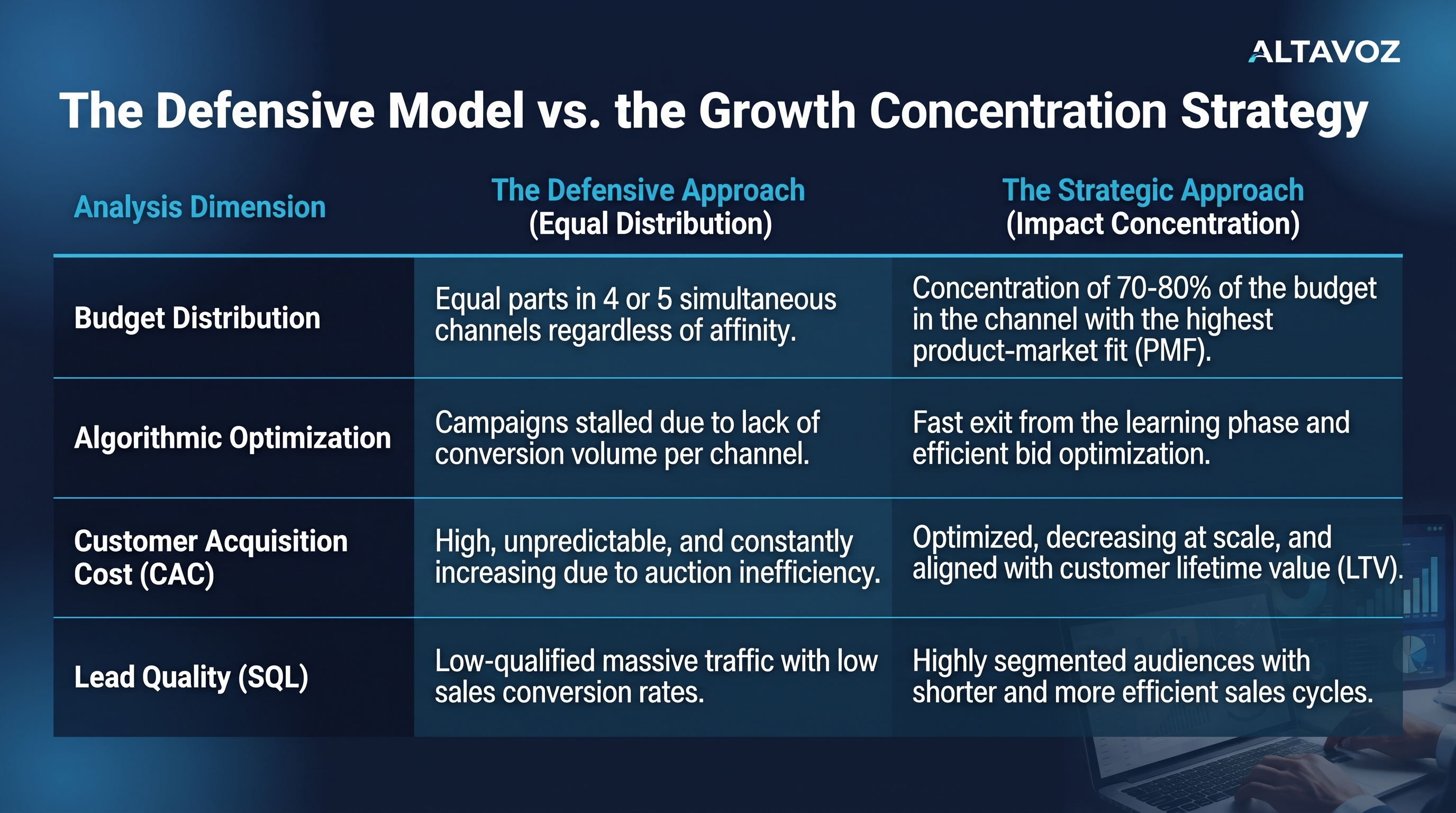
Methodology for structuring a traction-based budget allocation
Ensuring a predictable return on investment in advertising channels requires abandoning improvisation and applying data-driven resource allocation principles:
- The dominant primary channel rule: Concentrate initial financial effort on the channel where historical data proves the lowest acquisition cost and highest decision-maker affinity.
- Staged budgeting model (Channel Tiering): Assign core budget to the highest-converting channel (Tier 1), allocate a smaller percentage (15-20%) to controlled experimentation (Tier 2), and eliminate noise channels.
- Strict alignment with the commercial funnel: Ensure every dollar spent on advertising responds to a validated stage of the sales cycle, prioritizing search intent or industry authority over raw reach.
- Decisions based on LTV/CAC, not impressions: Measure advertising success based on mid-term profitability and customer retention, shielding the budget from the illusions of cheap clicks.
From scattered spend to business-traction investment
Knowing how to structure and concentrate advertising spend during a startup's growth stages is the hallmark of a marketing leader with financial vision. Organizations that successfully overcome the fear of concentration and commit to data-driven efficiency not only lower their acquisition cost but transform digital advertising into a predictable engine of scaling.
At Altavoz Comunicaciones, we understand that advertising budgets must be managed with analytical rigor and business vision. We help tech startups, CMOs, and growth leads design advertising, B2B performance, and digital marketing strategies that eliminate capital waste and build sustainable, measurable market growth.