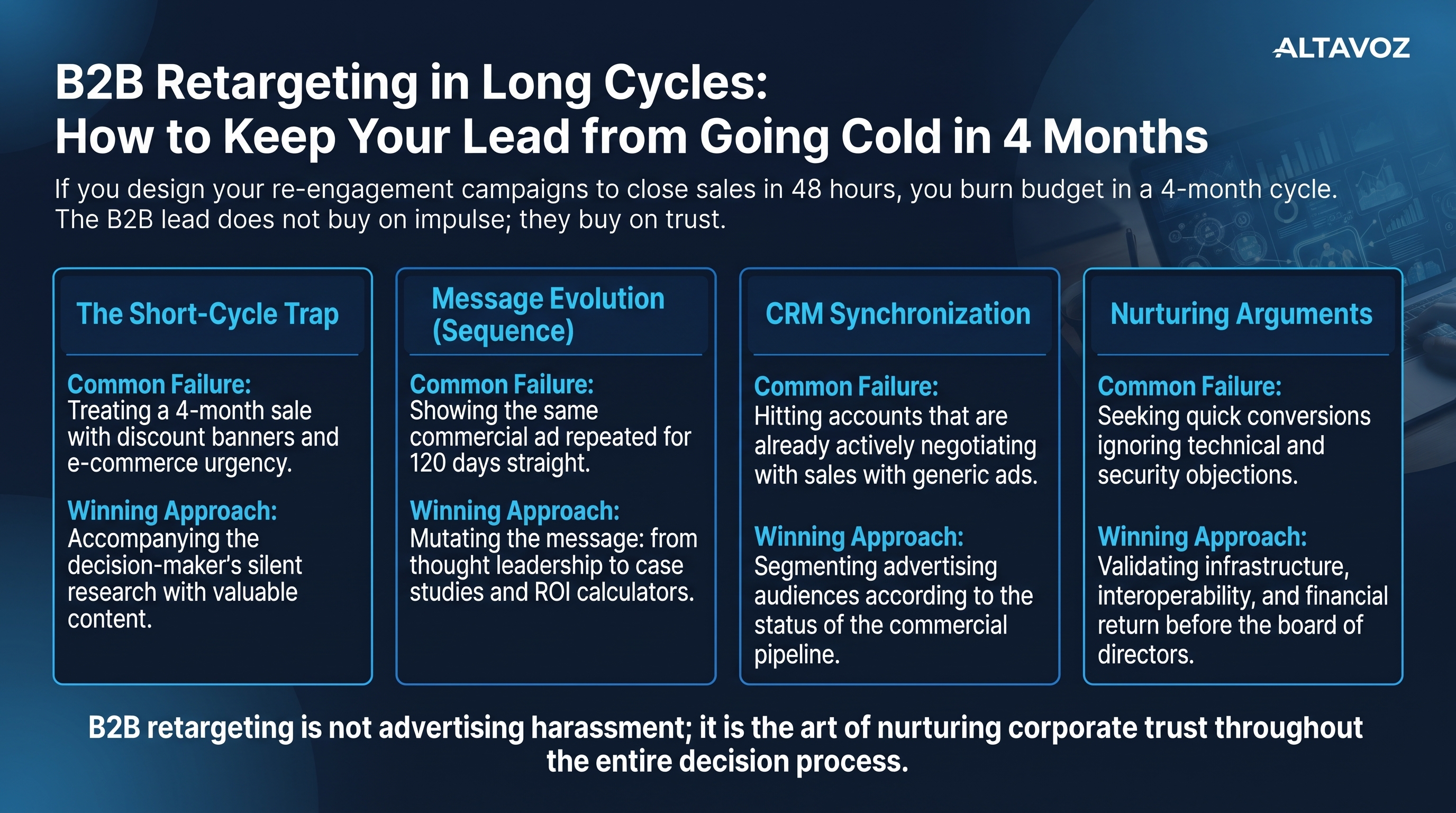
The scenario repeats itself at the end of every month in B2B SaaS growth committees: demand generation teams allocate considerable budgets to remarketing campaigns designed under B2C e-commerce logic. Aggressive "last chance" ads, immediate free trial calls to action, and generic discount banners follow CFOs or CTOs all over the internet. However, the average sales cycle for an enterprise software platform hovers around four months. Trying to accelerate a complex corporate decision with direct-response touches conceived for 48-hour cycles not only overwhelms the prospect but destroys brand equity.
This disconnect occurs when re-engagement ads are designed from tactical urgency rather than the maturation of the buying cycle. Decision-makers in B2B environments do not sign enterprise software contracts just because they saw a banner repeated three times on LinkedIn. They need security validation, industry case studies, architecture comparisons, and financial arguments to justify ROI to the board of directors. If retargeting ignores the friction of the consideration process, the lead cools down, marks the ad as intrusive, and ad spend evaporates into empty clicks.
The danger of treating the B2B pipeline like an impulsive purchase
Evaluating a re-engagement ad strategy based on immediate conversion metrics creates perverse incentives on ad platforms. When the algorithm is optimized solely to capture quick clicks on cold audiences who already visited the website, the system prioritizes peripheral profiles—such as interns, students, or employees without decision-making power—who interact out of curiosity but will never buy software.
In the high-complexity SaaS market, a four-month cycle involves phases of silent research, internal technical consultations, legal validation, and switching cost analysis. Bombarding the decision-maker with static creatives repeating the initial offer creates ad fatigue and positions the company as an immature vendor that fails to understand the timelines and demands of corporate sales.
4 Critical flaws in long sales cycle retargeting
To determine whether an acquisition strategy is guiding the prospect or simply wasting budget on ad harassment, demand generation managers must audit their management by evaluating the following factors:
- Creative monotony across all funnel phases: Displaying the exact same commercial ad throughout the 120 days of the sales cycle without updating the message based on the lead's level of progress.
- Lack of synchronization with technical depth: Ignoring that, after the first month, the prospect looks for architecture arguments, API integrations, and regulatory compliance (SOC2, GDPR), not basic commercial calls to action.
- Budget concentrated on saturated audiences: Injecting all retargeting spend into the first 7 days post-visit, abandoning the lead in the intermediate months where budget decisions are actually made.
- Disconnection with the sales team (Smarter CRM sync): Failing to segment ad audiences according to the lead's actual CRM status, hitting accounts already in advanced negotiations with an account executive with generic ads.
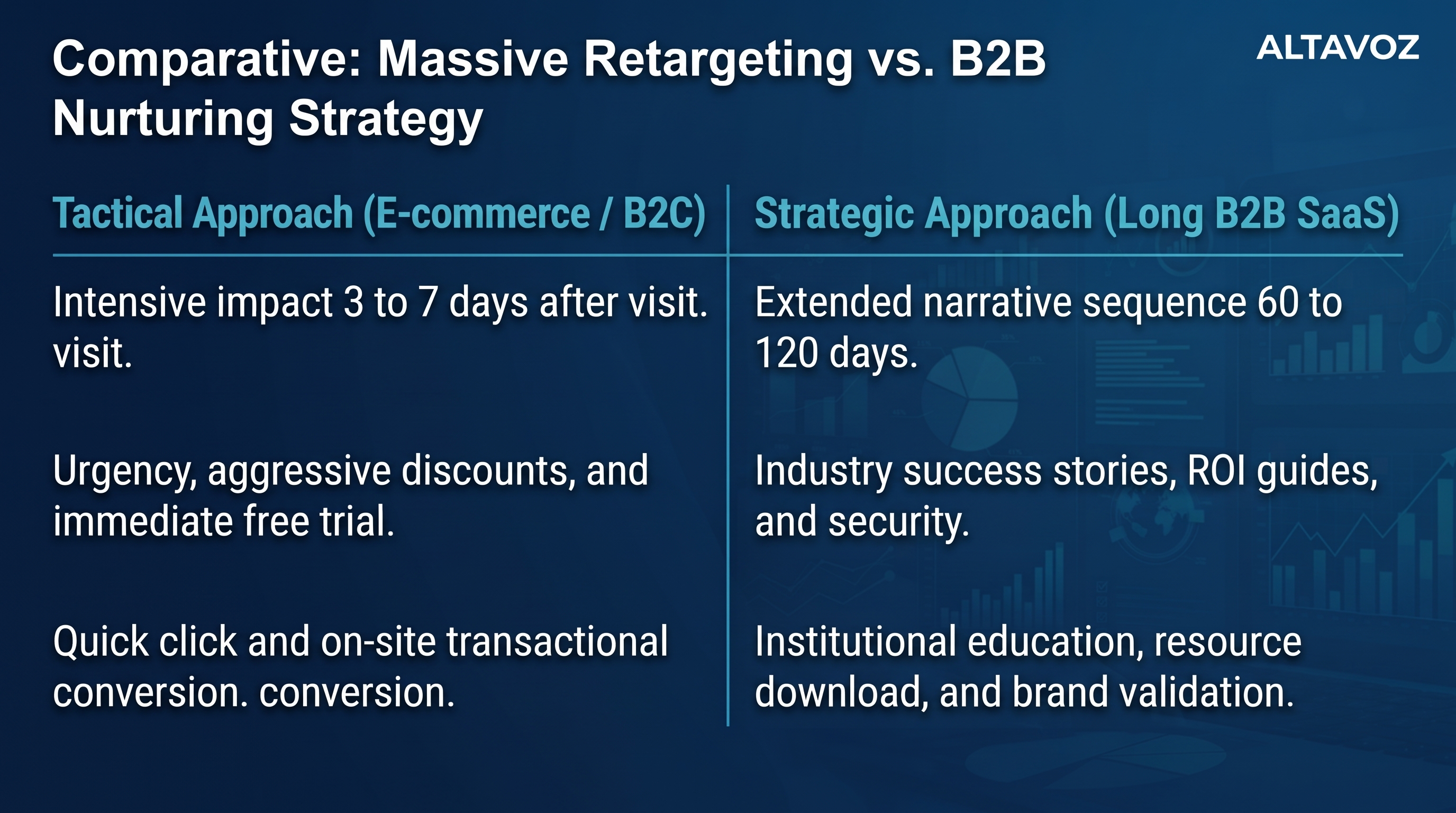
Comparison: mass retargeting vs. B2B maturation strategy

Methodology for structuring a staged retargeting sequence (pipeline nurturing)
Ensuring predictable return in four-month sales cycles requires abandoning mass touches and designing a sequenced content architecture:
- Discovery and initial validation phase (Days 1 to 30): Direct ads to resolve primary industry objections, displaying market comparisons and thought leadership articles that reinforce brand authority.
- Technical depth and risk mitigation phase (Days 31 to 75): Deploy content focused on platform security, ease of implementation, case studies with similar clients, and industry analyst reports.
- Financial justification and sales support phase (Days 76 to 120): Activate ROI calculators, total cost of ownership (TCO) analyses, and direct messaging supporting the sales team in closing the proposal.
- Dynamic segmentation connected to CRM: Automatically exclude leads who have already signed a contract or are in advanced closing stages with a human from general retargeting campaigns.
From ad harassment to intelligent Commercial guidance
Knowing how to structure a retargeting strategy aligned with actual decision timelines in the SaaS sector is the definitive competitive advantage for growth marketing teams. Organizations that leave behind the obsession with quick clicks and design content sequences based on lead maturation not only optimize their acquisition cost but turn digital ads into a silent, effective accelerator of corporate contracts.
At Altavoz Comunicaciones, we understand that B2B performance advertising requires analytical rigor and deep insight into the sales cycle. We help demand generation managers and tech companies design digital ad and content marketing strategies that eliminate budget waste and build lasting trust with decision-makers.