
The scenario repeats quarter after quarter in financial planning meetings of scaling tech companies: 95% of the advertising budget (ads spend) is rigidly concentrated between Meta Ads and Google Search/Performance Max. For CMOs and marketing directors, maintaining this structure feels like the safest and most predictable choice. However, as cost-per-click (CPC) and auction costs on these platforms increase by 15% each year due to competitor saturation, return on ad spend (ROAS) plummets, forcing the startup to burn more capital just to maintain the same acquisition volume.
This vulnerability occurs when ad strategy is designed from operational inertia and fear of exploring unfamiliar territory. Organizations confuse scale with channel exclusivity, ignoring that the digital ecosystem offers multiple emerging spaces and specialized B2B channels where direct competition is still low and acquisition costs are significantly more profitable. Relying exclusively on an advertising duopoly turns the startup into a hostage of opaque algorithms and uncontrollable rate hikes.
The Danger of the Saturated Auction in Tech Growth
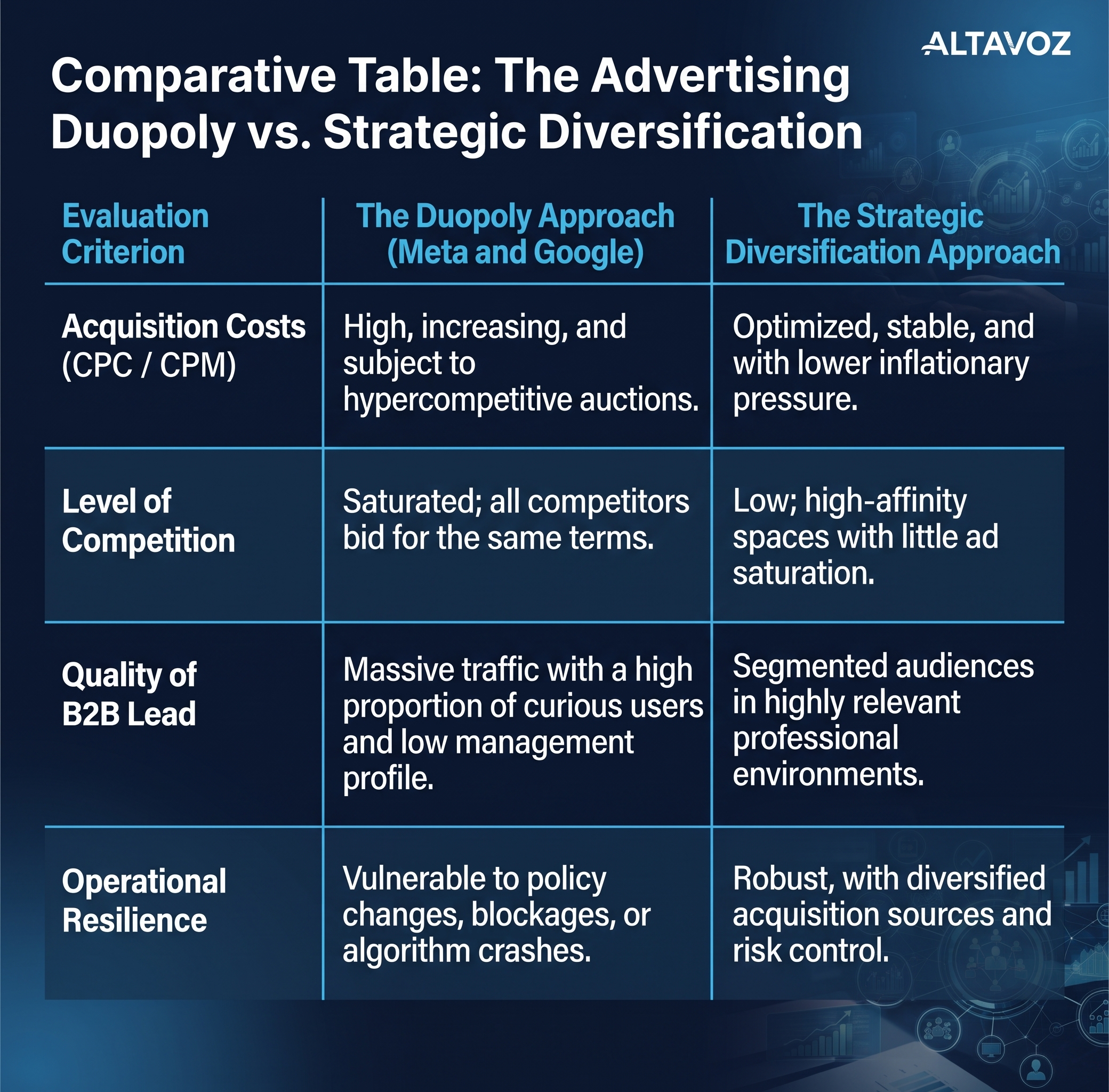
Evaluating acquisition performance solely based on the convenience of managing two platforms creates a false sense of control. When every competitor in the SaaS or fintech industry bids on the same keywords on Google or targets the exact same audiences on Meta, the auction becomes a checking-account war where the one with the deepest pockets wins, not necessarily the one with the best product.
In the tech market, where sales cycles are complex and the target audience consists of highly qualified profiles (CTOs, CFOs, operations directors), saturating mass channels generates immediate ad fatigue. Users learn to ignore institutional announcements, CTR drops, and the cost per qualified lead (SQL) rises to unsustainable levels that erode the company's operating margin.

4 Critical flaws of relying exclusively on Meta and Google
To determine whether an acquisition strategy is operating with a long-term vision or simply tied to a dangerous dependency, CMOs must audit their management by evaluating the following factors:
- Uncontrolled inflation of acquisition costs (CAC): Assuming quarterly increases in CPC and CPM without diversifying into alternative channels where the cost per impact is more efficient.
- Ad blindness in saturated audiences: Repeatedly hitting the same decision-makers on generalist social media, causing brand rejection.
- Vulnerability to algorithmic or policy changes: Being at the mercy of unforeseen modifications in privacy policies, cookie restrictions, or Google and Meta quality adjustments that paralyze lead generation overnight.
- Inability to capture demand in niche channels: Ignoring specialized platforms, industry newsletters, tech podcast sponsorships, or secondary professional networks where competition has not yet inflated auction prices.
The advertising duopoly vs. strategic diversification
Methodology for diversifying the ad mix without risking the budget
Ensuring predictable growth in tech startups requires leaving the duopoly comfort zone and structuring a multicanal expansion strategy based on controlled experimentation:
- The 80/20 rule in experimentation: Allocate 80% of the budget to core, validated channels and 20% to testing emerging or specialized channels (such as advanced LinkedIn, niche newsletters, technical communities, or B2B platform placements).
- Buyer persona digital footprint mapping: Accurately identify where the decision-maker spends professional time when not browsing mass social media or traditional search engines.
- Bounded proofs of concept (60-day pilots): Launch pilot campaigns on alternative channels with defined budgets and clear attribution metrics to evaluate cost per lead before scaling investment.
- Synchronization of content and niche ads: Accompanying entry into new channels with technical, high-value messaging that directly resonates with the specialized audience's needs.
From duopoly to acquisition sovereignty in your startup
Knowing how to break dependence on traditional platforms and diversify the performance mix is the hallmark of a CMO with strategic vision. Tech startups that manage to explore new channels before they saturate not only lower their acquisition cost but build a solid, resilient advertising operation ready to lead their market.
In Altavoz Comunicaciones, we understand that digital advertising in the tech sector requires constant innovation and financial rigor. We help CMOs and scaling companies design multicanal performance marketing strategies that eliminate dependence on a single ecosystem and empower sustainable business growth.