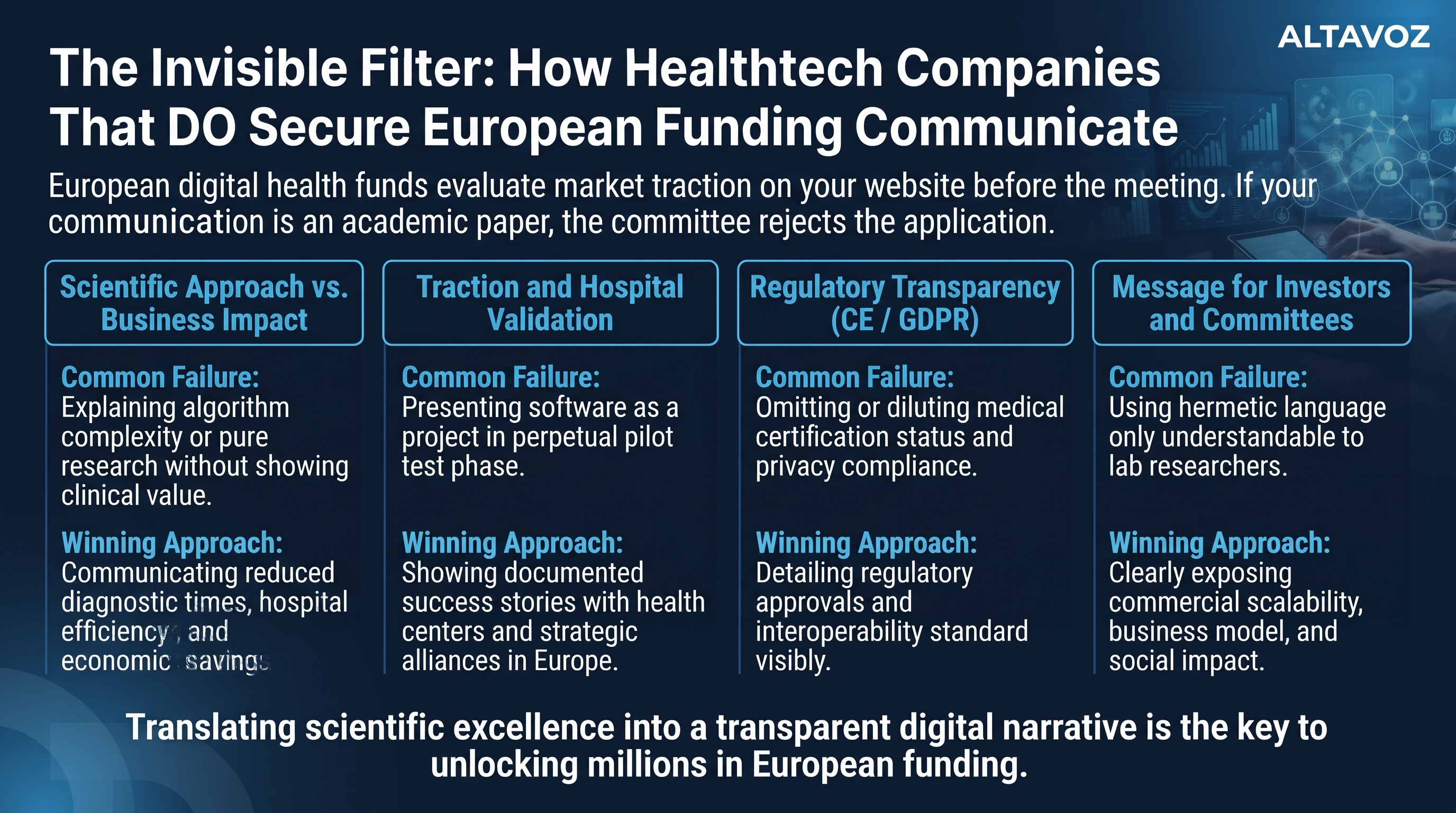
The scenario is well-known in the biomedical innovation ecosystems of Madrid, Barcelona, and Valencia: highly qualified healthtech founders—physicians, researchers, and data scientists—develop health devices or platforms with impeccable technical rigor and promising clinical trials. However, when applying to European funds such as the European Innovation Council (EIC Accelerator) or Horizon Europe programs, the application is rejected in the first evaluation phase. The flaw is rarely in the patent, but rather in an opaque digital proposal that fails to demonstrate market traction, interoperability, or regulatory viability before international committees that demand commercial clarity prior to the defense meeting.
This disconnect occurs when communication strategy is reduced to an academic or institutional exercise, ignoring that institutional evaluators and venture capital (VC) funds analyze a startup's digital footprint as the primary indicator of operational maturity. If the corporate website looks like a university paper, success stories are absent, or regulatory terminology is confusing, the investor assumes an unsustainable adoption risk. In the healthtech sector, how digital innovation is communicated is the direct reflection of the team's capacity to lead the transformation of the healthcare system.
The Danger of Academic Rhetoric in Healthcare Technology Communication
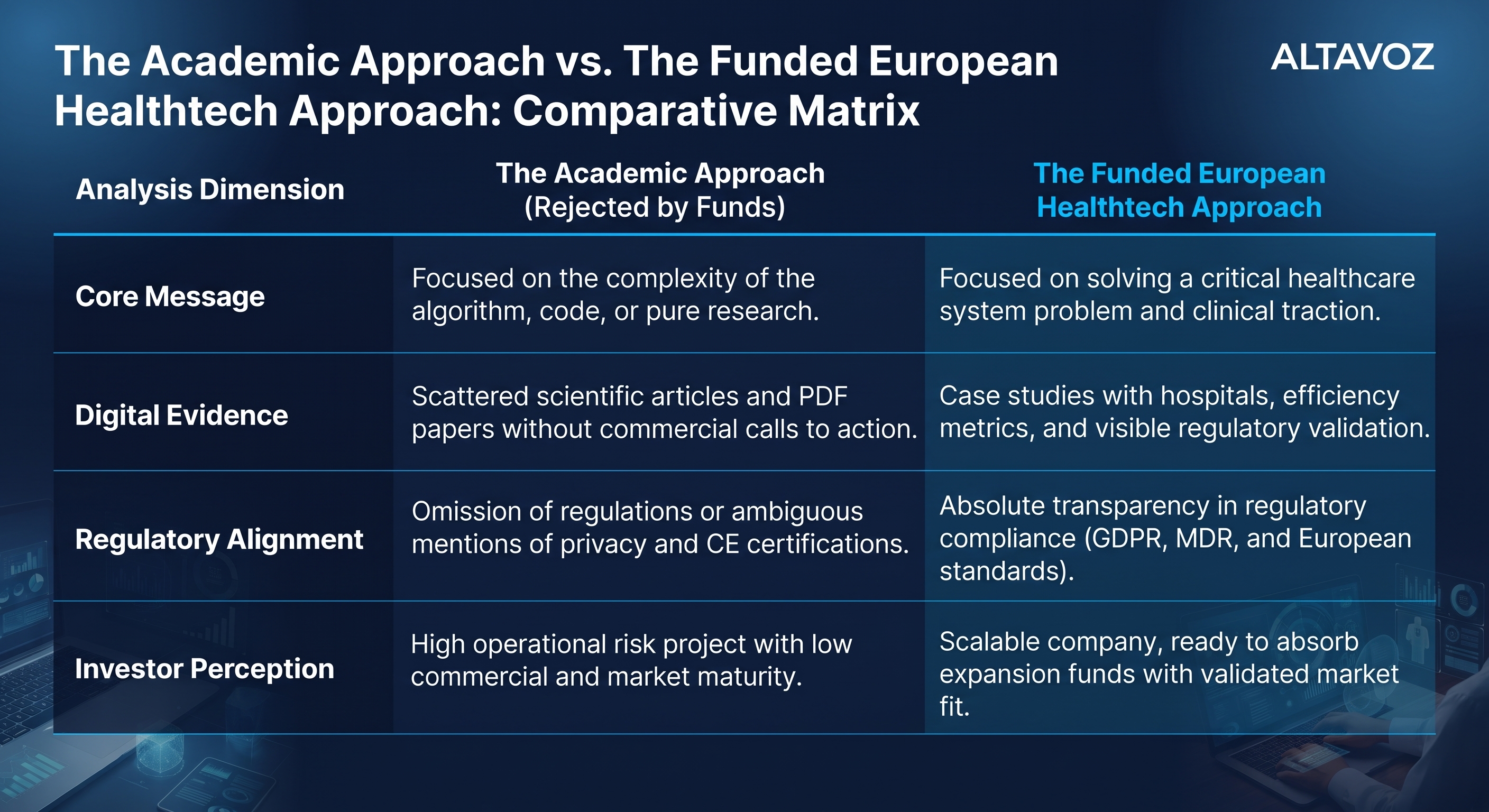
Evaluating the success of a communication strategy based on the technical density of its content generates immediate rejection by European evaluation committees. When the focus is placed exclusively on scientific technicalities, the startup's narrative drifts away from the real problems of health systems and patients.
European fund evaluators are not looking for laboratory summaries, but rather evidence of adoption, business-oriented clinical validation, and scale-up readiness (EIC Readiness). A digital health startup that does not clearly communicate its integration with electronic health records (EHR) or its compliance with privacy regulations (such as GDPR and EU medical device standards) transmits operational vulnerability, losing access to millions of euros in non-dilutive grants and venture capital.

4 Critical flaws in healthtech digital communication during fundraising
To determine whether a health technology startup is communicating with the rigor demanded by European investors or simply burning opportunities due to a generic website, founders and marketing directors must audit their strategy by evaluating the following factors:
- Absence of business-oriented clinical validation: Communicating technical software features instead of demonstrated benefits in reduced diagnostic times, hospital efficiency, or financial relief for healthcare system payers.
- Regulatory and interoperability opacity: Failing to transparently specify certification status (CE mark, FDA, or compliance with the European Health Data Space), generating immediate distrust in adjudication committees.
- Lack of visible market traction: Presenting the solution as a project in a perpetual pilot phase, without documented success stories with hospitals, private clinics, or validated strategic alliances in Europe.
- Incomprehensible value proposition for non-technical profiles: Using hermetic language that makes it difficult for investment fund analysts to quickly grasp the monetization model, scalability, and social impact of the innovation.
Comparative matrix: the academic approach vs. funded healthtech communication strategy
Methodology for structuring a digital communication strategy suited for EIC accelerator
Ensuring the approval of European digital health funds requires aligning online presence with the strict criteria of excellence, impact, and implementation demanded by the European Commission:
- The value proposition clarity rule: Explaining within the first five seconds of the website what clinical problem the technology solves, who pays for it, and what efficiency metrics endorse its use.
- Dedicated Clinical Validation and Regulation section: Creating a transparent institutional space detailing ongoing clinical trials, European regulatory approvals, and agreements with benchmark healthcare institutions.
- Hospital impact testimonials and metrics: Incorporating statements from medical directors, heads of service, or hospital managers certifying the operational value and ease of integration of the solution.
- Alignment with EU priorities: Explicitly connecting the corporate narrative with sustainable digital transformation, health cybersecurity, and equity in healthcare access promoted by the European Union.
From the laboratory to europe: communicating with executive rigor
Knowing how to structure and transparently present the digital value proposition in a healthtech is the definitive competitive advantage in institutional fundraising processes. Emerging companies that successfully translate their scientific excellence into a clear, regulated, and impact-focused commercial narrative not only secure millions in European funding but also consolidate their leadership in the digital health market.
At Altavoz Comunicaciones, we understand that digital reputation and corporate communication in the healthtech sector must meet the highest standards of international rigor. We help founders and executives of health technology companies design positioning, public relations, and corporate communication strategies that transform scientific complexity into commercial traction and investor confidence.