Many digital health startups in Mexico are founded by physicians, scientists, or engineers with deep technical expertise. The product works, has solid clinical backing, and addresses an urgent need—yet the homepage is packed with acronyms, protocols, and system architecture descriptions that only another specialist can decode. The outcome is predictable: patients, caregivers, or corporate buyers leave within seconds because they cannot answer a basic question: "What does this actually solve for me or my organization?"
This guide is built for founders, marketing directors, and product leaders at healthtech companies in Mexico who need to translate their value proposition without losing scientific credibility. Below, you will find editorial criteria, a messaging translation matrix, and an operational framework to turn your website and digital channels into clear tools for acquisition and trust.
Why Medical Jargon Stalls Conversion in Digital Health
Technical language serves a precise purpose inside a hospital or medical congress: it eliminates ambiguity among peers. However, when carried unfiltered onto a commercial website, it creates an immediate cognitive barrier. A user looking to manage a symptom, track a chronic condition, or purchase a health benefit for their workforce is not grading your academic rigor on the first click; they are looking for relief, certainty, and ease of use.
In the Mexican market—where skepticism toward complex medical processes and concern over hidden costs are common—cryptic messaging is often perceived as distance or lack of empathy. If your main headline talks about "algorithmic interoperability for predictive cardiometabolic risk stratification," everyday users do not feel impressed; they feel excluded. Clarity does not water down science; it makes it accessible to the person making the decision.
- What to verify: Take the first three blocks of your homepage (headline, subheadline, and service overview) and ask someone outside the healthcare sector to explain in one sentence what you sell and who you help. If they hesitate or repeat your words without understanding them, you have a narrative translation gap.
- Red flag: Your product pages show higher bounce rates than the rest of your site, or your sales team spends the first fifteen minutes of every call explaining what the platform actually does.
Separate Your Narrative by Audience: Patient, Clinician, and B2B Buyer
One of the most common mistakes in healthtech storytelling is trying to address the end patient, the medical board, the HR director, and venture investors on the exact same screen. Each audience arrives with a different friction point and expects a different level of technical depth.
Patients need to know what everyday problem you solve, how much time they save, and what the step-by-step experience looks like. Healthcare professionals look for clinical validation, workflow integration, and data security. Corporate buyers and insurers evaluate claims reduction, regulatory compliance, and ease of rollout. Blending all three registers into a single paragraph creates a hybrid message that convinces no one.
- How to apply it: Build separate navigation paths from your main menu ("For Patients," "For Clinicians," "For Companies"). Reserve plain, benefit-driven language for the homepage and patient pages, and house clinical evidence, technical sheets, and scientific publications in a dedicated "Evidence" or "Clinical Backing" section.
- Mistake to avoid: Writing your user-facing pages to impress investors or the founding team's medical peers.
The Three-Layer Method to Translate Science into Benefits
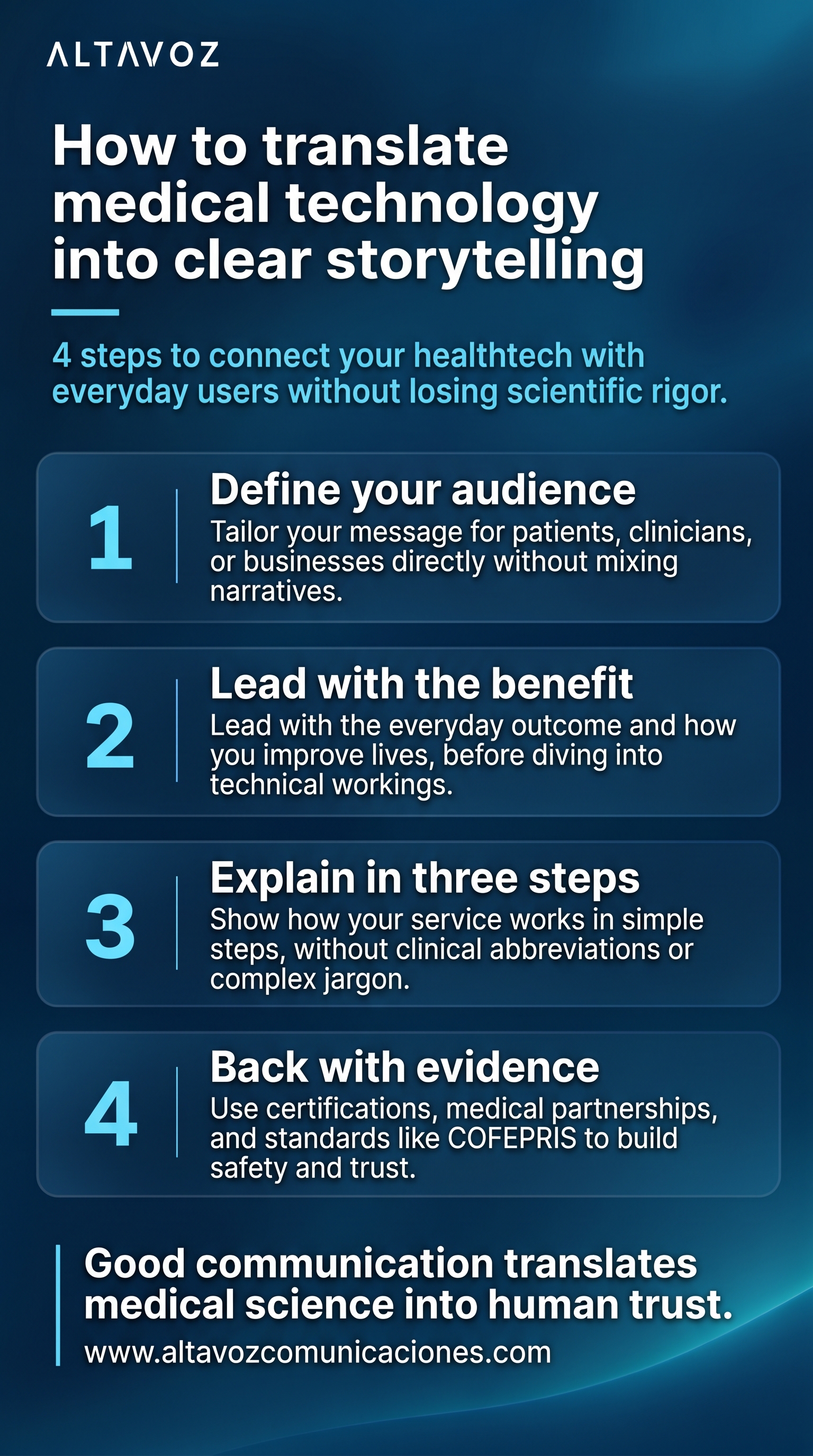
Effective digital health storytelling does not mean removing rigor; it means organizing it into progressive layers of reading. Instead of leading with the technical mechanism, open with the human outcome and position the scientific explanation as verifiable proof.
The first layer is the concrete outcome: what changes in the user's routine from day one (for example, getting a preliminary care orientation in minutes or refilling a prescription without waiting in line). The second layer is the simplified mechanism: how the service works in three plain steps, free of clinical shorthand. The third layer is technical backing: certifications, alignment with applicable Mexican regulations such as COFEPRIS guidelines or data privacy standards, and medical partnerships that validate your promise.
- What to ask your team: Before publishing any commercial copy, require every technical feature to be paired with its direct benefit using a simple formula: "What the technology does + what it prevents or improves in the user's life."
- Red flag: Your website explains in detail how your AI model was trained or which sensors your device uses, but fails to explain what actually happens after a user signs up.
Rigor, Ethics, and Compliance: Being Clear Without Overpromising
In healthcare, simplifying your message must never cross into commercial exaggeration or unsubstantiated clinical claims. Mexican users are particularly wary of "miracle solution" rhetoric, and the regulatory environment requires accuracy regarding the actual scope of any digital health service.
The right balance relies on plain, direct, and verifiable language. Avoid absolutes like "guaranteed cure," "100% error-free," or "replaces your doctor" when your platform operates as a triage, guidance, or monitoring tool. Explaining honestly what your solution does—and when a healthcare professional steps in—builds far more trust than grandstanding adjectives.
- What to verify: Ensure all commercial copy clearly distinguishes between informational guidance, preventive monitoring, and formal medical diagnosis, and that it passes both editorial and legal or regulatory review.
- Mistake to avoid: Replacing medical jargon with empty advertising clichés that undermine clinical credibility and expose the brand to reputational or regulatory risk.

Translation Matrix: From Scientific Paper to Clear Storytelling
Use this matrix as an operational reference to audit and rewrite key messages across your website, sales decks, and digital campaigns.
| Technical approach (paper style) | User-centered approach (clear storytelling) | Where to place technical backing |
|---|---|---|
| "Asynchronous telemonitoring platform for patients with non-communicable chronic pathologies." | "Track your diabetes or hypertension daily from home, with early alerts sent to your doctor." | "How it works" section or downloadable sheet for clinics. |
| "Natural language processing triage algorithm with high clinical specificity." | "Answer five simple questions about your symptoms and know in minutes whether you need urgent care or a scheduled visit." | "Clinical Evidence & Methodology" page. |
| "Interoperable electronic health record integration under international standards." | "Your medical history always organized and accessible, without carrying paper test results to every appointment." | "Security & Compliance" section or B2B page. |
| "Comprehensive therapeutic adherence solution via automated reminders." | "We help you stay on top of your medications and follow-up visits so your treatment actually works." | Use cases and impact metrics in the corporate section. |
Common Storytelling Mistakes in Healthtech Startups
- Leading the website with technology instead of the problem: Opening with "generative AI," "healthcare blockchain," or "advanced biotech" forces users to guess what the product is for.
- Using medical or corporate acronyms without explanation: Terms like EHR, clinical SaaS, or specialized biochemical markers push non-specialist readers away.
- Ignoring the local Mexican context: Literally translating copy from US startups overlooks Mexico's healthcare realities, out-of-pocket spending dynamics, and local patient habits.
- Hiding the cost or first step: Failing to clarify whether the service requires insurance, direct payment, or an employer plan creates unnecessary friction and drops conversion.
- Confusing empathy with a patronizing tone: Writing clearly does not mean talking down to the patient; the tone should remain adult, respectful, calm, and practical.
Frequently Asked Questions
Does removing medical jargon make my healthtech look less credible to doctors?
No, as long as you separate your spaces. The main website should be clear to anyone, while a dedicated section for healthcare professionals can present studies, protocols, and clinical terminology without alienating patients.
How can I tell if my website sounds too technical?
Run quick reading tests with five people who match your end-user profile but do not work in healthcare. If they cannot explain your value proposition after ten seconds on your homepage, the copy needs editorial rewriting.
What kinds of stories work best in healthtech storytelling?
Concrete everyday scenarios work best: cutting wait times, avoiding unnecessary commutes, giving peace of mind to a caregiver, or making treatment follow-up easier. Stories should center on the user's real friction, not the company's technical origin.
When should we highlight certifications or regulatory compliance?
Place them as trust anchors near decision points (forms, pricing, or B2B pages) and in a dedicated trust section. They reinforce confidence once the user already understands what problem you solve.
From Technical Complexity to a Narrative That Converts
Medical innovation only creates impact when people understand how to use it and why they should trust it. Structuring your storytelling does not require dumbing down your product; it requires building a messaging architecture that respects the user's time, addresses their real need, and backs every promise with verifiable rigor.
Does your healthtech already have a strong product, yet your website and commercial materials still struggle to connect with patients or corporate buyers?
At Altavoz Comunicaciones, we help technology and healthcare companies across Mexico and Latin America structure their brand narrative, public relations strategy, editorial communication, and digital positioning (SEO/GEO) to turn complex solutions into clear, measurable messages.